Lab: AXI4-Burst Mode
Simple example of AXI4-Burst Mode
This lab is an example of AXI4 data transfer in burst mode. It takes in a given sample of values and provides the square root.
1)Vivado_HLS: Generating RTL code from C/C++ code
In this section you learn how to create a project in Vivado_HLS, synthesis your code, and generate RTL.
1.1)Download code and create a Vivado_HLS project
Download and unzip axi4_burst.zip. Generate your project using the provided script.tcl file:
Linux: open a terminal, make sure your environment is set, navigate to streamMul folder, and run the following
$ vivado_hls -f script.tcl
Windows: open vivado_hls command line and run the following
$ vivado_hls -f script.tcl
Now you can open your project in Vivado_HLS. It should look like this:

in and out are ports set to AXI4 interface. They are also set as axilite interfaces as the AXI4 interfaces are given the offsets as the corresponding slaves. AXI4 is master(m_axi) based unlike axilite which is slave(s_axilite) based protocol. Since it is slave based we know which address to write and read from using the general purpose port. But AXI4 which we are implementing is master based and hence we use the high performance ports for communication to the PS just like DMA. We do not know the address to read and write and setting the offset to slave allows us to control AXI4-Master just like AXILite slave. len and return which are number of samples and control signals respectively are axilite.
1.2) Generate RTL code and export it
Click on Run C Synthesis to generate RTL code. After it is done, you can check your resource utilization and timing report. Your latency is unknown (?) because your loop size (len) is a variable.

Now you can export your RTL code by clicking on Export RTL:
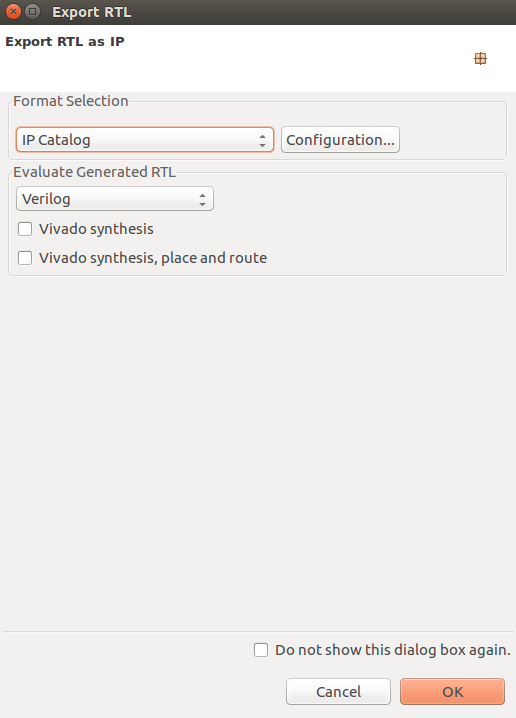
After exporting is done, you can close and exit from Vivado_HLS.
2) Vivado: Generating bitstream from RTL code
In this section we import our RTL code from last section, add some required IPs, and generate our bitstream
2.1) Create a new Vivado project
Open your Vivado tool and create a new project. Select an appropriate location for your project and leave the default project name as is (project_1).
Select RTL Project and check Do specify not sources at this time.
Select xc7z020clg400-1 for your part:
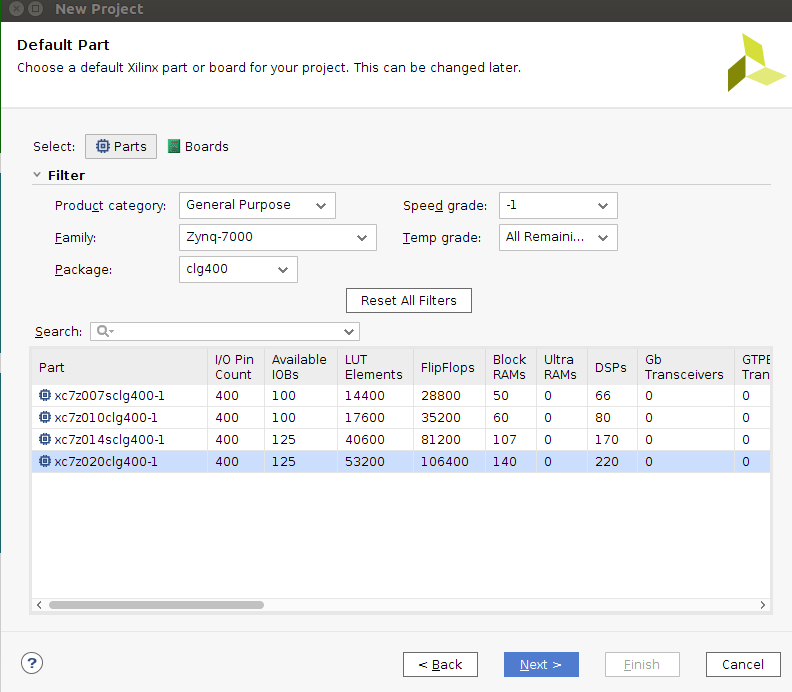
2.2) Import RTL code
Under Flow Navigator, click on IP Catalog. Right click on the opened window and select Add Repository. Navigate to your Vivado_HLS project > solution1 > impl > ip and select it:

2.3) Add IPs to your design
Under Flow Navigator, click on Create Block Design. Leave the design name as is (design_1). In the newly opened window you can add IPs by clicking on the plus sign.
Add ZYNQ7 Processing System to your design:
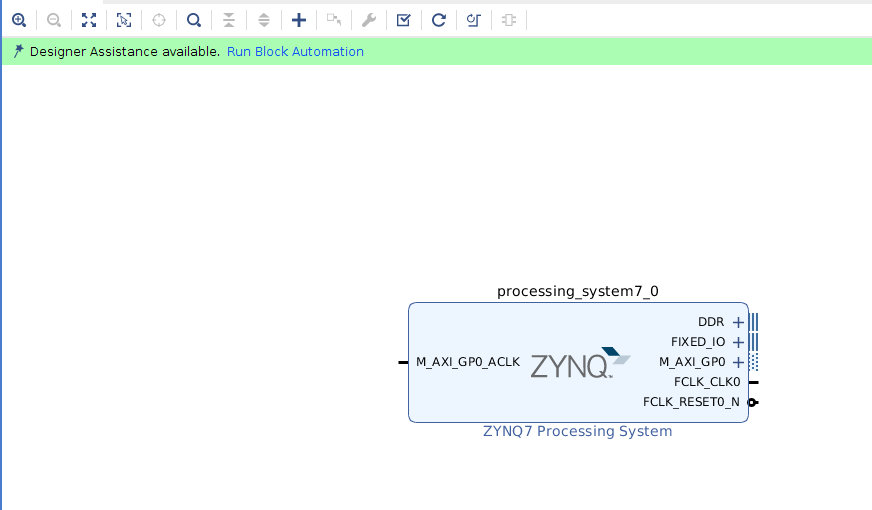
Double click on ZYNQ7 IP to customize it. In the opened window, double click on High Performance AXI 32b/64b Slave Parts:
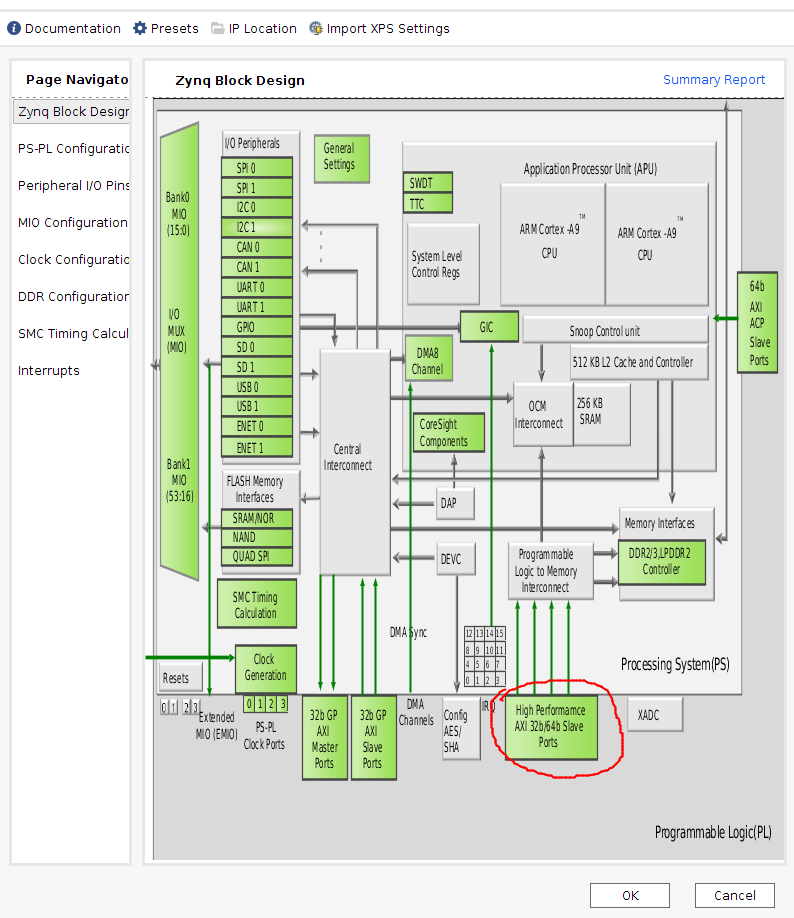
Select and check S AXI HP0 interface:

Add the axi4 sqrt IP to the design.

2.4) Automatic connections
1- Click on Run Block Automation
2- Click on Run Connection Automation and select all.Click ok.

3- Click on Run Connection Automation again and select all. Click ok.

This is how the final design should look

2.5) Generate bitstream
1- Save your design CTRL+S or File > Save Block Design.
2- Validate your design: Tools > Validate Design
3- In Sources, right click on design_1, and Create HDL Wrapper. Now you should have design_1_wrapper.
4- Generate bitstream by clicking on Generate Bitstream in Program and Debug
2.6) Post bitstream Generation
In sources, expand design_1_wrapper::design_1_i::design_1::axi4_sqrt_0::design_1_axi4_sqrt_0_0::inst : axi4_sqrt, double click on axi4_sqrt_sqrt_s_axi_U , and note the address for in_r , out_r , len as 0x10 , 0x18 and 0x20 respectively. We need this address in our host program.

You can close and exit from Vivado tool.
Copy your project directory > project_1 > project_1.runs > impl_1 > design_1_wrapper to your project directory > project_1 and rename it to axi4_sqrt.bit.
Copy your project directory > project_1 > project_1.srcs > sources_1 > bd > design_1 > hw_handoff > design_1.hwh to your project directory > project_1 and rename it to axi4_sqrt.hwh.
3) Host program
In this section we use python to test our design
3.1) Move your files
Create a new folder in your PYNQ board and move both axi4_sqrt.hwh and axi4_sqrt.bit into it.
3.2) Python code
Create a new Jupyter notebook and run the following code to test your design:
from pynq import Overlay
from pynq import Xlnk
import numpy as np

ol=Overlay('axi4_lab.bit')
sqrt_ip=ol.axi4_sqrt_0

length=40
inpt=Xlnk().cma_array(shape=(length,),dtype=np.float32)
outpt=Xlnk().cma_array(shape=(length,),dtype=np.float32)
a=[i*i for i in range(length)]
np.copyto(inpt,a)
soft_op=np.sqrt(inpt)

sqrt_ip.write(0x20,length)
sqrt_ip.write(0x10,inpt.physical_address)
sqrt_ip.write(0x18,outpt.physical_address)
sqrt_ip.write(0x00,1)

print("Hardware Output","Software Output \n")
for i in range(length):
    print(outpt[i],"\t\t  ",soft_op[i])